At a glance
| Overview | Details |
| Condition | Silent or asymptomatic gallstones |
| What it Means | Gallstones are present in the gallbladder but have not caused typical gallstone symptoms |
| How They are Found | Often discovered incidentally during an abdominal ultrasound or other imaging performed for another reason |
| Do They Always Need Treatment? | No. Most people with asymptomatic gallstones in an otherwise normal gallbladder and biliary tree do not require treatment unless symptoms develop |
| Usual Approach | Observation is generally appropriate when gallstones are confined to the gallbladder and are not causing symptoms or complications |
| When Surgery Becomes More Relevant | If typical biliary symptoms develop, complications occur or particular clinical circumstances make preventive treatment appropriate |
| Possible Complications | Gallstones can occasionally lead to biliary colic, acute cholecystitis, bile duct obstruction, cholangitis or gallstone pancreatitis |
| Surgical Treatment | When gallbladder removal is indicated, laparoscopic cholecystectomy is generally the standard surgical approach |
| When to Seek Medical Attention | New or persistent upper abdominal pain, fever, jaundice, persistent vomiting or significant abdominal tenderness should be assessed |
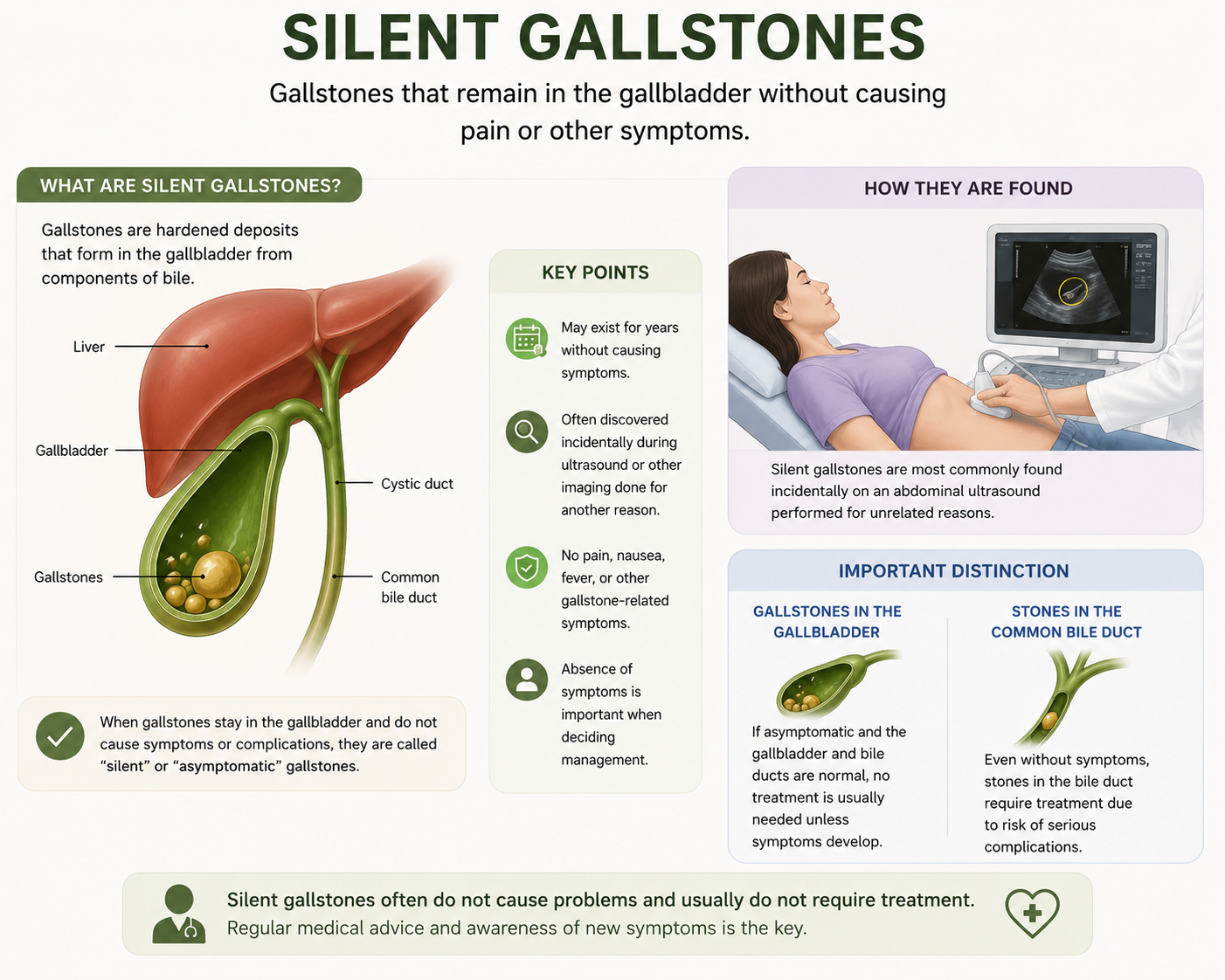
Gallstones are often discovered incidentally during an abdominal ultrasound performed for a health screening or while investigating an unrelated concern. For someone who has never experienced typical gallstone pain or a gallstone-related complication, seeing “gallstones” on an imaging report can raise an immediate question: if the stones are not causing any problems now, should they be removed before they do?
In most cases, the answer is no. The presence of gallstones alone does not mean that surgery is necessary. When stones remain within the gallbladder, cause no symptoms and are not associated with abnormalities of the gallbladder or biliary system, they can usually be left untreated. Current NICE guidance recommends reassurance and no treatment for people with asymptomatic gallbladder stones when the gallbladder and biliary tree are otherwise normal, unless symptoms subsequently develop [1].
This approach reflects an important principle in gallstone management: treatment should be guided by the clinical significance of the stones, not simply by their presence on a scan. For many people, gallstones remain silent throughout life and never create a reason for intervention.
In this blog, we explain what silent gallstones are, why they often do not require treatment, what can happen if they are left alone and the circumstances in which gallbladder removal may still be considered.
Gallstones are solid deposits that form from components of bile within the gallbladder. They can vary considerably in size and number, from fine deposits or small stones to larger individual stones.
The term “silent gallstones” refers to gallstones that are present without causing the typical symptoms or complications associated with gallstone disease [2]. A person may have one or several stones in the gallbladder for years without knowing they are there. In many cases, they are discovered incidentally when an ultrasound, CT scan or other abdominal investigation is performed for an unrelated reason.
This absence of symptoms is more than a description of how the patient feels; it is an important part of deciding whether treatment is necessary. A gallstone that has remained confined to the gallbladder without causing biliary pain, inflammation or obstruction is approached differently from a stone that has already produced symptomatic disease [3].
It is also important to distinguish asymptomatic gallbladder stones from stones in the common bile duct. Once a stone has migrated from the gallbladder into the common bile duct, it can obstruct the normal flow of bile and create potentially serious complications. NICE therefore recommends bile duct clearance for common bile duct stones even when they have not yet caused symptoms, with laparoscopic cholecystectomy also offered to appropriate patients [4].
In other words, being told that you have an “asymptomatic gallstone” is not enough information on its own. Where the stone is located and whether there are associated abnormalities are also important when deciding what should happen next.
The discovery of gallstones can make preventive removal seem logical: if the stones have the potential to cause problems in the future, why not remove the gallbladder before that happens? For most people with genuinely asymptomatic gallstones, however, the potential benefit of preventive surgery is not sufficient to justify routinely operating on an otherwise symptom-free patient.
One reason is that many silent gallstones never become symptomatic. European Association for the Study of the Liver (EASL) guidance reports that approximately 0.7–2.5% of people with asymptomatic gallstones develop symptoms each year, while serious gallstone-related complications occur at a considerably lower annual rate [5]. This means that the presence of gallstones does not make future illness inevitable.
Surgery also needs to offer a meaningful benefit to justify exposing a patient to an operation. Cholecystectomy, or surgical removal of the gallbladder, is an established and effective treatment for symptomatic gallstone disease [6]. However, like any operation, it involves anaesthesia and carries potential surgical complications. Removing the gallbladder from every person in whom an incidental stone is detected would therefore mean operating on many people who might never have developed a problem from their gallstones.
For this reason, the decision can be understood as a balance between two risks:
When gallstones are asymptomatic and there are no other clinical reasons for intervention, the balance generally favours observation. This is why major clinical guidance does not routinely recommend prophylactic cholecystectomy simply because gallstones have been identified.
Importantly, observation does not mean that the finding has been dismissed. It means that there is currently no sufficient clinical benefit from intervention to outweigh the disadvantages of surgery. The patient should understand the finding, recognise symptoms that may indicate a change and seek reassessment if those symptoms develop.
For many people, nothing happens. The stones remain within the gallbladder without producing symptoms, sometimes for many years. This is precisely why routine surgery is generally unnecessary for uncomplicated asymptomatic gallstones.
A proportion of people will eventually develop symptoms, but it is not possible to predict with certainty which individual patient will do so. When problems occur, they usually begin when a stone interferes with the normal drainage of bile or moves into the biliary ducts.
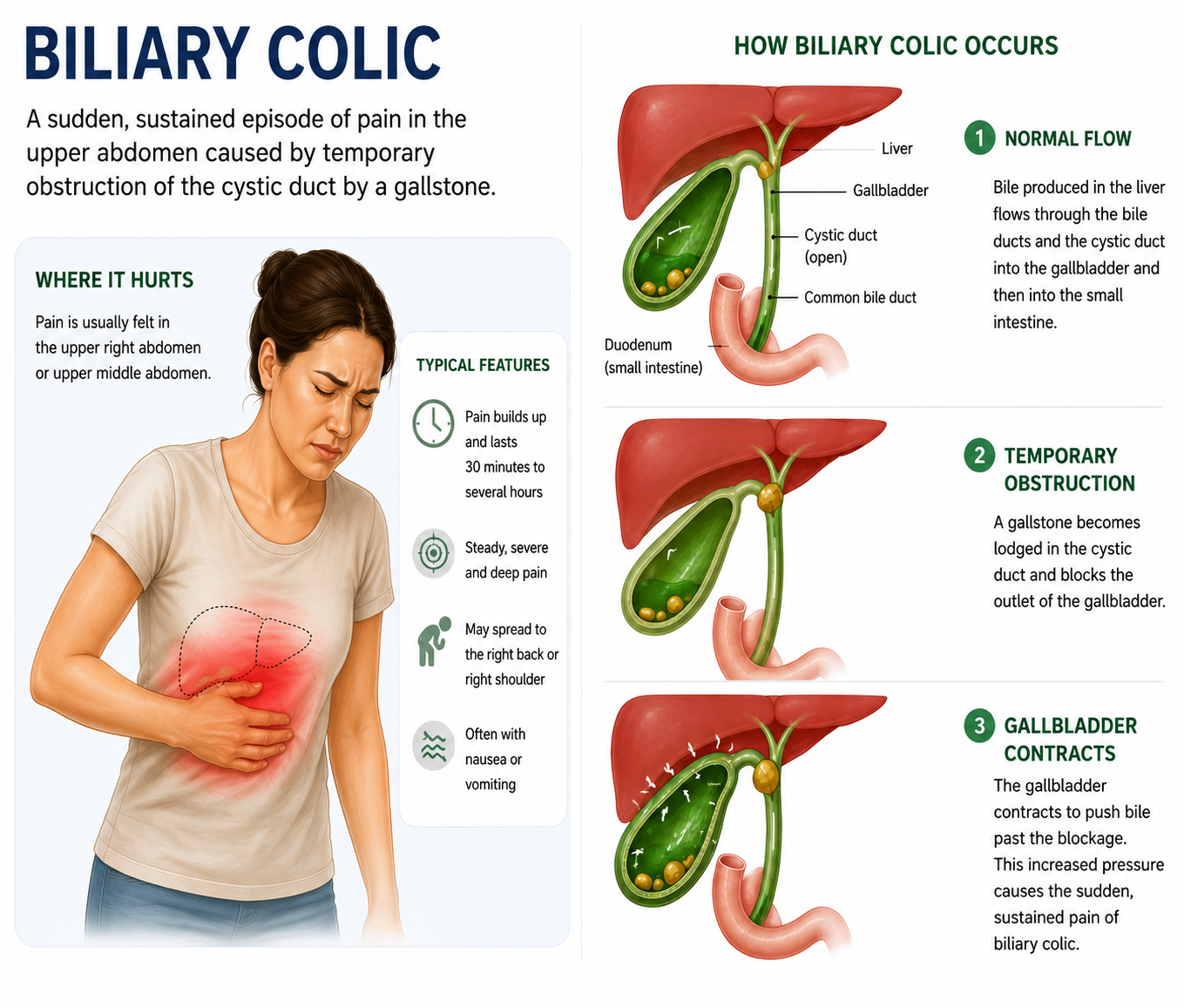
The first indication that previously silent stones have become clinically significant may be biliary colic, typically a sustained episode of pain in the upper abdomen caused by temporary obstruction of the gallbladder outlet [7]. Other possible complications include:
Although these complications are important, their possibility should be kept in perspective when considering an asymptomatic patient. EASL guidance reports that complications in people with asymptomatic gallstones occur at relatively low annual rates, supporting conservative management for most patients who have never experienced symptoms [13].
What matters is a change in the clinical picture. Once a person begins experiencing characteristic biliary pain or develops a gallstone-related complication, the stones can no longer be considered truly silent. At that point, the balance between observation and treatment needs to be reassessed.
The distinction between silent and symptomatic gallstones is clinically important because the same finding on an ultrasound can lead to very different management depending on what the stones are doing.
| Feature | Silent Gallstones | Symptomatic Gallstones |
| Symptoms | No typical gallstone symptoms | Biliary pain or other gallstone-related symptoms have occurred |
| How They May Be Found | Often discovered incidentally during imaging | Frequently identified during investigation of symptoms |
| Immediate Treatment | Usually unnecessary in uncomplicated cases | Treatment is more likely to be indicated |
| Usual Management | Observation and awareness of symptoms | Clinical or surgical assessment |
| Cholecystectomy | Not routinely recommended solely because stones are present | Commonly recommended for suitable patients with symptomatic gallbladder stones |
| What Changes Management | Development of symptoms, complications or other relevant clinical findings | Frequency and severity of symptoms, complications and the patient’s overall health |
The important dividing line is therefore not simply whether gallstones are present, but whether they have begun to cause clinically meaningful disease. A person whose gallstones were appropriately observed when they were first discovered may later become a candidate for surgery if recurrent biliary pain or a gallstone-related complication develops. Management can therefore change over time as the clinical significance of the stones changes.
Observation is appropriate for most people with uncomplicated silent gallstones, but there are selected situations in which surgery may still be discussed even when typical gallstone symptoms are absent. These decisions are usually based on the wider clinical picture, not on the presence of gallstones alone.
A specialist may take a different approach when there are additional findings involving the gallbladder or biliary system, or when an individual’s medical circumstances make a future gallstone complication more difficult to manage. Examples may include:
These situations require individual assessment because the evidence and recommendations are not identical for every patient or clinical scenario. A finding that increases concern in one person may not carry the same significance in another.
It is common to assume that a very large gallstone must be removed, while a small stone is relatively harmless. In practice, stone size alone does not determine whether surgery is necessary, and the same is true of the number of stones present.
A person may have several gallstones without ever experiencing symptoms, while another person with a single stone may develop biliary pain or a complication. What matters more is how the stones are behaving and where they are located.
When reviewing an ultrasound, a doctor may consider:
Certain unusual stone or gallbladder characteristics may influence specialist recommendations in selected cases, but there is no simple rule that a particular stone size or number automatically means surgery is required.
For that reason, the measurement recorded on an ultrasound report should not be interpreted in isolation. The significance of a stone depends on the complete clinical and imaging assessment.
If gallstones have been found incidentally, patients sometimes expect that they will need regular scans to check whether the stones are growing. For uncomplicated asymptomatic gallstones, however, routine serial ultrasound is generally not required simply to monitor stone size or number.
This is because management is usually influenced more by whether symptoms develop or the clinical situation changes than by small differences in stone measurements between scans. A gallstone becoming slightly larger on imaging does not automatically mean that treatment is needed.
Repeat imaging may still be appropriate when there is another reason to reassess the gallbladder, such as:
Patients with straightforward silent gallstones are therefore usually advised to remain aware of relevant symptoms and seek medical review if their condition changes, instead of undergoing repeated scans solely because stones are present.
Silent gallstones become clinically important when they begin causing symptoms or interfere with the normal drainage of bile. New symptoms should therefore prompt reassessment, particularly when they are persistent, recurrent or severe.
Symptoms that may require medical attention include:
Typical gallstone pain often occurs when a stone temporarily obstructs the outlet of the gallbladder. More persistent pain, particularly when accompanied by fever or tenderness, may indicate inflammation. Jaundice can suggest obstruction within the bile ducts and requires prompt assessment.
It is also important not to assume that every episode of abdominal discomfort in someone with gallstones must be caused by them. Indigestion, reflux, peptic disease, liver conditions and other abdominal disorders can produce overlapping symptoms. A medical assessment helps determine whether the gallstones are actually responsible and whether management needs to change.

Silent gallstones usually remain under observation because they are not causing symptoms or complications. Surgery becomes more relevant when that changes, for example, when a person develops recurrent biliary pain, gallbladder inflammation, bile duct stones or gallstone pancreatitis.
For suitable patients with symptomatic gallstones, laparoscopic cholecystectomy is generally the standard definitive treatment. The gallbladder is removed together with the stones because leaving the gallbladder in place means new stones can form and symptoms may recur.
Surgery is not recommended on symptoms alone without considering the wider picture. Doctors also take into account:
A person may therefore be observed safely while the stones remain silent and later be considered for surgery if they begin causing clinically significant problems.
Most people with silent gallstones can continue their usual daily activities without special restrictions. Work, exercise and travel can generally continue as normal unless another health condition limits them.
A strict fat-free diet is also not routinely necessary simply because gallstones have been found. A balanced diet, stable healthy weight and avoidance of rapid weight loss are generally more appropriate.
The main practical advice is to remain alert to changes. If meals repeatedly trigger upper abdominal pain, or if symptoms such as persistent pain, fever, vomiting or jaundice develop, medical reassessment is important because the gallstones may no longer be truly silent.
Finding gallstones unexpectedly can make preventive surgery seem like the safest option, particularly when patients are concerned about what might happen in the future. However, the presence of gallstones alone does not generally justify removing an otherwise normal, symptom-free gallbladder.
Many silent gallstones never cause a problem, and for most people with uncomplicated asymptomatic stones, observation is an appropriate management strategy. The decision changes when the clinical situation changes. Recurrent biliary pain, gallbladder inflammation, stones entering the bile ducts, jaundice, pancreatitis or other complications may create a clear reason to reconsider treatment.
Additional gallbladder abnormalities or individual medical circumstances can also influence the decision in selected patients. This is why management should be based on the whole clinical picture, not simply the presence, size or number of stones seen on an ultrasound report.
If gallstones have been discovered unexpectedly and you are unsure whether observation or treatment is appropriate, consider scheduling a consultation with a specialist at Tan Siong San Surgery for an individual assessment and discussion of your scan findings.


Tan Siong San Surgery. © All Rights Reserved 2025


